


New Labour Laws Simplified: 2025
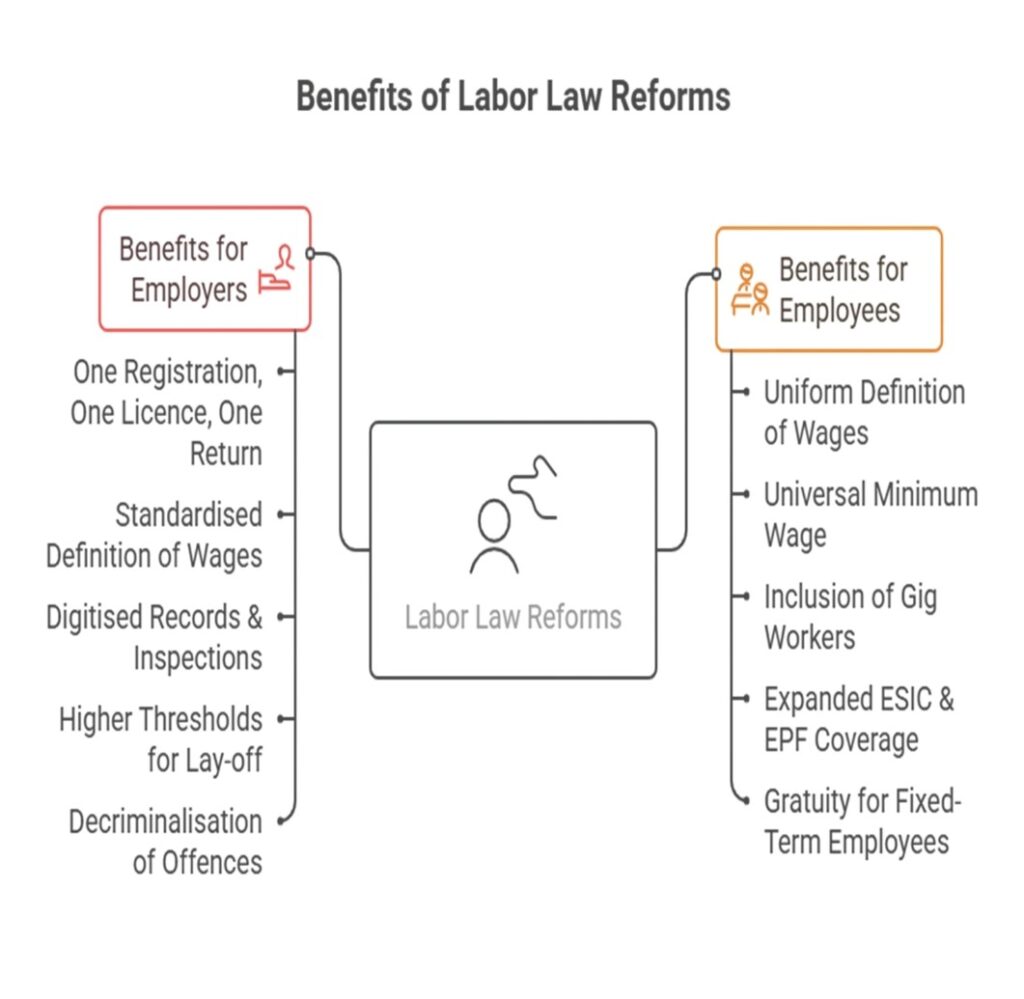
- Four major Codes now replace 29 labour laws, creating a single structure for wages, industrial relations, social security, and workplace safety.
- The Codes offer expanded worker protections while delivering significant advantages to employers through digitised compliance, higher operational thresholds, and decriminalisation of minor offences.
- Modern provisions—gig worker coverage, fixed-term employment, national worker databases, and uniform wage definitions—align organisations with today’s labour market realities.
Scope
The Code on Wages, 2019; The Industrial Relations Code, 2020; The Code on Social Security, 2020; and The Occupational Safety, Health and Working Conditions Code, 2020—mark a comprehensive restructuring of the nation’s labour regulatory framework. These Codes consolidate 29 central legislations into four harmonised statutes, designed to simplify compliance, strengthen worker protection, and create a more predictable business environment. Their significance lies in establishing uniform definitions, streamlining registration and reporting obligations, and enhancing social security and safety standards. This legislative transformation aims to address long-standing procedural complexities while promoting transparency, empowerment of the workforce, and economic efficiency.
Major Reforms - Benefits to Stakeholders
The four Labour Codes introduce several pivotal reforms affecting wages, industrial relations, social security, and occupational safety. They collectively represent a progressive yet compliance-intensive shift that organisations must understand. Below Tables Show Major reforms from perspective of employees and employers:
| Sno | Benefits to Employees | Benefits to Employers |
|---|---|---|
| A. Wage-Related Reforms (Code on Wages, 2019) | ||
| 1 | Universal minimum wage coverage protects low-income workers across all sectors. | Uniform wage rules remove complexity of multiple wage legislations. |
| 2 | Floor wage ensures adequate living standards and prevents exploitation. | Predictability in wage planning due to standardised national floor wage. |
| 3 | Equal pay for similar work with gender neutrality increases fairness. | Reduced litigation risk from pay discrimination claims. |
| 4 | Timely payment provisions protect employees from delayed salaries. | Clear timelines simplify payroll SOPs and diminish disputes. |
| 5 | Overtime at twice the normal rate ensures fair compensation. | Standard norms streamline shift planning and workforce optimisation. |
| 6 | Transparent criteria for wage fixation based on skill and job conditions. | Employers can objectively classify roles and structure wage grids. |
| 7 | Universal coverage of wage payment (removal of ₹24,000 limit). | Uniform applicability reduces administrative segmentation. |
| 8 | Inspector-cum-Facilitator encourages guidance over coercive action. | Reduced harassment and increased cooperative compliance environment. |
| 9 | Decriminalisation of minor offences reduces punitive fear. | Monetary penalty regime reduces risk of imprisonment for procedural lapses. |
| 10 | Higher threshold for lay-off/closure (100→300 workers). | Greater operational freedom and reduced approval dependency. |
| 11 | Digital record-keeping improves transparency. | Reduced physical inspections and consistent compliance processes. |
| B. Industrial Relations Reforms (Industrial Relations Code, 2020) | ||
| 1 | Fixed-Term Employees receive equal benefits and gratuity after one year. | Workforce flexibility without long-term employment liability. |
| 2 | Re-skilling fund for retrenched workers supports employability. | Predictable financial outlay for retrenchment obligations. |
| 3 | Recognised Negotiating Union/ Council enhances collective representation. | Streamlined negotiations instead of fragmented union interactions. |
| 4 | Expanded definition of worker widens protective coverage. | Clarity on workforce classification reduces disputes. |
| 5 | Clear notice rules for strikes reduce abrupt disruptions. | Mandatory notice ensures business continuity planning. |
| 6 | Work-from-home recognition improves flexibility for workers. | Operations can continue during disruptions; reduced overhead costs. |
| 7 | Women’s representation in grievance committees ensures equitable redressal. | Structured grievance handling reduces reputational risks. |
| 8 | Direct access to tribunals enables faster justice. | Faster dispute resolution reduces operational uncertainty. |
| 9 | Two-member tribunals (judicial + administrative) ensure consistency. | Predictable outcomes improve industrial stability. |
| C. Social Security Reforms (Code on Social Security, 2020) | ||
| 1 | ESIC coverage expands pan-India, improving healthcare access. | Voluntary ESIC option gives flexibility for small establishments. |
| 2 | Gig and platform workers included under social security protection. | Clarified aggregator obligations reduce classification disputes. |
| 3 | Social Security Fund provides support for unorganised workforce. | Charges capped at 5% of payments to gig workers, protecting cost structure. |
| 4 | Gratuity eligibility for FTE after one year increases financial security. | Predictable gratuity liability enhances workforce planning. |
| 5 | Expanded dependent definition widens family protection benefits. | Reduced ambiguity in claims handling and documentation. |
| 6 | Commuting accidents are deemed employment-related ensuring compensation. | Clear rules reduce litigation on accident classification. |
| 7 | Time-bound EPF inquiries protect workers from prolonged uncertainty. | Limits prevent retrospective scrutiny and ensure closure of compliance cycles. |
| 8 | EPF appeal deposit reduced (25%) eases employee cash flow. | Lower deposit reduces employer’s financial burden in litigation. |
| 9 | Digitised compliance brings transparency and ease of access. | Reduced paperwork, fewer visits to EPF/ESIC offices, and lower compliance cost. |
| 10 | Inspector-cum-Facilitator encourages supportive compliance environment. | Web-based randomised inspection reduces arbitrariness. |
| 11 | Compounding of first-time offences lowers penalty impact. | Swift resolution without criminal consequences. |
| 12 | Vacancy reporting enhances visibility of job opportunities. | Streamlined recruitment processes and easier talent access. |
| D. Occupational Safety & Working Conditions Reforms (OSH Code, 2020) | ||
| 1 | Safe working conditions enhanced through unified safety standards. | One licence/one return reduces compliance burden. |
| 2 | Annual free health check-ups improve preventive care. | Early detection of health risks reduces absenteeism. |
| 3 | Women allowed to work night shifts with safeguards promotes inclusion. | Availability of women employees for night operations increases workforce capacity. |
| 4 | Appointment letters with job details ensure clarity of rights. | Standardised documentation reduces disputes and strengthens HR governance. |
| 5 | Inter-state migrant workers get travel allowance and portability of benefits. | Mandatory declaration enables accurate workforce planning and reduces uncertainty. |
| 6 | National database for unorganised workers improves access to schemes. | Facilitates easier hiring of skilled labour with verified records. |
| 7 | Wider definition of ISMW includes self-migrating workers for better protection. | Employers can operate legally with broader corrective compliance scope. |
| 8 | Safety committees promote workplace participation in safety governance. | Reduces accidents, enhancing productivity and lowering legal liability. |
| 9 | Victim compensation ensures timely financial support. | Clear liability allocation reduces court delays and indirect losses. |
| 10 | Contract labour reforms (higher thresholds, auto-licensing). | Simplified licensing cuts administrative delays and business interruption. |
| 11 | Working hour clarity (8 hours/day, 48 hours/week) protects wellbeing. | Predictable scheduling reduces overtime disputes and payroll errors. |
| 12 | Decriminalisation promotes a civil penalty model. | Financial penalties instead of imprisonment reduce operational risk. |
| 13 | Inspector-cum-Facilitator ensures advisory compliance support. | Reduces adversarial inspections and fosters cooperative regulation. |
How to be Prepared
Businesses must adopt a structured and proactive approach to ensure compliance with the Labour Codes.
- Comprehensive impact assessment covering wages, staffing models, contract labour deployment, ESIC/PF applicability, and safety standards.
- Revising HR policies, employment contracts, wage structures, and shift schedules in line with uniform definitions and statutory thresholds.
- Internal controls must be strengthened for digital record-keeping, periodic audits, and algorithm-based inspection readiness. Establishing clear governance frameworks for handling retrenchment, disciplinary procedures, and union negotiations will be crucial.
- Companies engaging gig or platform workers should re-evaluate aggregator obligations and financial provisioning. Safety management systems must be upgraded to meet OSH requirements, including constitution of safety committees and deployment of site-specific SOPs.
- Training initiatives for HR, payroll, plant supervisors, and compliance teams will ensure uniform understanding. Ultimately, organisations that embrace the Codes with robust SOP-driven processes and technology-enabled compliance will be better positioned to minimise risk, enhance workforce trust, and benefit from streamlined regulatory operations.
CA Mahipal Sharma | Partner | FCA | CISA | B.Com
Contact: +91 7023030160 | email: mahipal013@gmail.com
Share this article:




