


ITC Reversal of Capital Goods 2025
Scope
The determination of input tax credit (ITC) on capital goods used partly for taxable supplies and partly for exempt supplies remains one of the more intricate compliance areas under the GST framework. Unlike input goods and input services, capital goods involve long-term usage and attribution over their useful life, thereby necessitating a distinct computational mechanism. The relevance of this subject lies in its direct impact on cash flows, output tax liability, and interest exposure for registered persons, particularly those operating mixed-supply businesses. Rule 43 of the CGST Rules, 2017, read with section 17 of the CGST Act, lays down a detailed yet mechanical method for attribution and reversal of ITC on capital goods. While the computations appear cumbersome, the underlying principle is straightforward—credit must align with the extent of taxable use. This article explains the framework, operational mechanics, exceptions, and sector-specific deviations, especially for real estate projects.
Major Considerations
Basic principle of ITC on Capital Goods
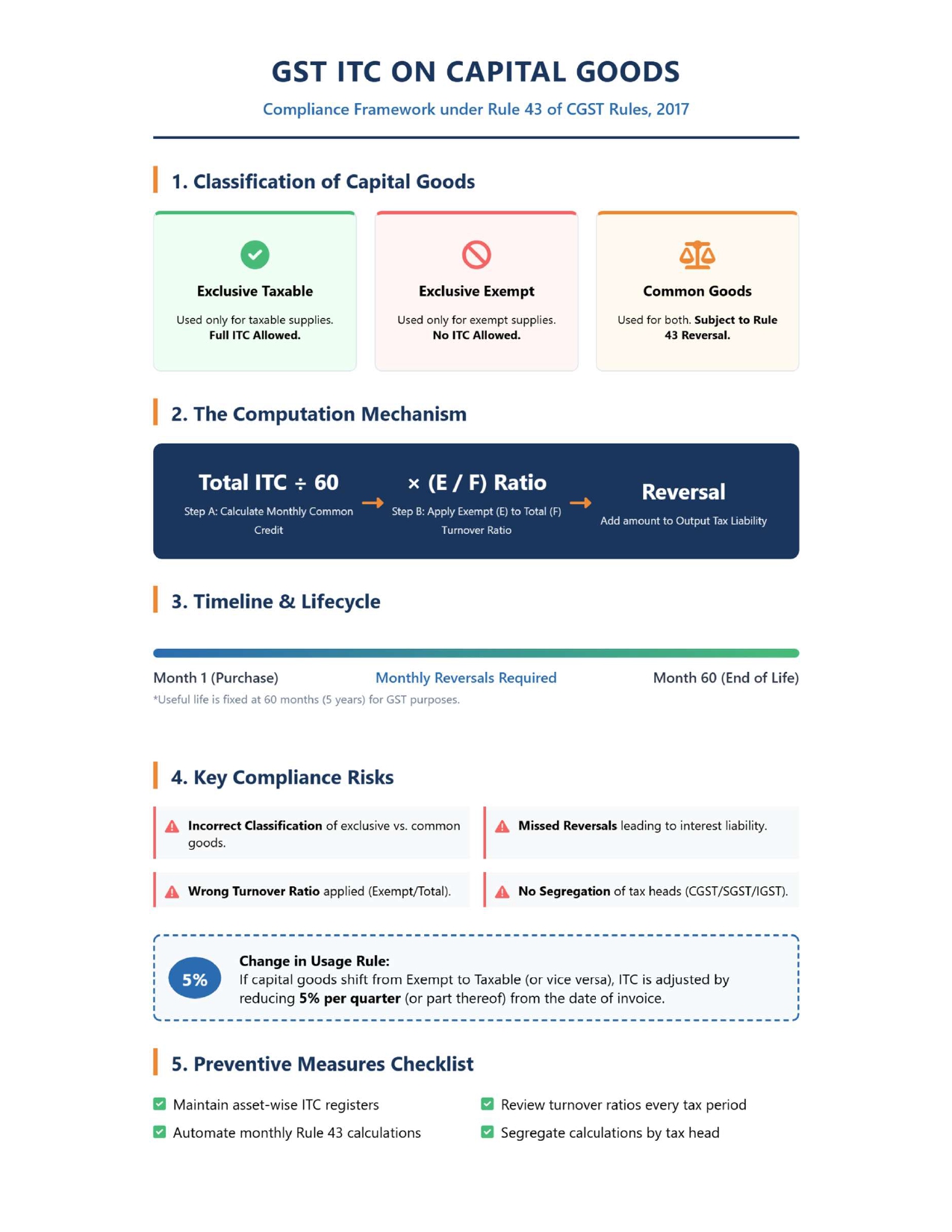
Where capital goods are used partly for effecting taxable supplies (including zero-rated supplies) and partly for effecting exempt supplies, ITC is not available in full. Instead, the credit must be restricted proportionately, following a mechanism broadly similar to that applicable to common input goods and input services. However, unlike inputs, the attribution for capital goods is spread over a fixed useful life of sixty months.
The computation begins with a mandatory classification of capital goods into three distinct categories:
-
Capital goods used exclusively for exempt supplies:
No ITC is admissible on such capital goods. The tax paid to the supplier is permanently blocked and must not be taken into the electronic credit ledger. -
Capital goods used exclusively for taxable supplies:
Full ITC is available in respect of these capital goods, subject to section 16(3) of the CGST Act, i.e., depreciation is not claimed on the tax component under the Income-tax Act. -
Common capital goods:
Capital goods that are used commonly for both taxable and exempt supplies fall under this category and form the core of Rule 43 computation.
Mechanism for common capital goods
The total ITC attributable to common capital goods is first identified. This amount is then divided by 60 months, representing the deemed useful life of capital goods under GST law. The resultant figure represents the monthly common credit, which is initially credited in full to the electronic credit ledger.
Subsequently, for each tax period, the registered person is required to compute the proportion of exempt turnover to total turnover. This ratio is applied to the monthly common credit to determine the portion attributable to exempt supplies. The resulting amount must be reversed every month by adding it to the output tax liability.
| Particulars | Treatment |
|---|---|
| Useful life of capital goods | 60 months |
| Monthly ITC | Total common ITC ÷ 60 |
| Reversal basis | Exempt turnover ÷ Total turnover |
| Mode of reversal | Added to output tax liability |
Interest implication on reversal
The phrase “with applicable interest” used in the rules is not elaborated upon with precision. In my opinion, interest should arise only where the reversal amount is not added to the output tax liability by the due date of return filing, i.e., 20th of the succeeding month. Where reversal is made in time, charging interest on legitimately availed ITC would lack legal and equitable justification.
No annual true-up for capital goods
Unlike input goods and input services, the GST law does not require a final annual reconciliation or true-up of ITC on capital goods at the end of each financial year. Monthly reversals continue throughout the useful life, without any year-end adjustment, except in the case of real estate projects.
Tax-wise segregation
All computations under Rule 43 must be carried out separately for CGST, SGST, IGST, and UTGST. Cross-utilisation or aggregation across tax heads is not permitted.
Change in usage of capital goods
-
From exempt to taxable use:
Where capital goods earlier used exclusively for exempt supplies are later deployed for taxable supplies, ITC can be availed proportionately by reducing the tax paid on such capital goods at 5% per quarter or part thereof. -
From taxable to exempt use:
Conversely, where capital goods initially used exclusively for taxable supplies are later used for exempt supplies, ITC must be reversed using the same 5% per quarter methodology.
Statutory framework and definitions
Rule 43(1) of the CGST and SGST Rules, 2017, governs the attribution of ITC on capital goods used partly for business and partly for non-business purposes, or partly for taxable and partly for exempt supplies. The definition of “capital goods” for this purpose includes “plant and machinery” as explained in section 17 of the CGST Act and reiterated in the Explanation below Rule 45 of the CGST Rules.
Risk
| ✓ Incorrect classification of capital goods as exclusive or common, leading to excess or short availment of ITC. | ✓ Delay in adding reversal amounts to output tax liability, exposing the taxpayer to interest liability. |
| ✓ Failure to compute and reverse proportionate ITC on common capital goods on a monthly basis. | ✓ Errors in applying the 5% per quarter adjustment where the usage of capital goods changes from taxable to exempt or vice versa. |
| ✓ Wrong application of exempt-to-total turnover ratio, resulting in inaccurate reversal amounts. | ✓ Non-compliance with special finalisation and allocation rules applicable to real estate projects, increasing audit and litigation risk. |
| ✓ Non-segregation of ITC calculations for CGST, SGST, IGST, and UTGST, causing statutory non-compliance. |
Proactive Actions
| ➤ Establish a clear classification framework to identify capital goods used exclusively for taxable, exclusively for exempt, and common purposes at the time of procurement. | ➤ Ensure strict segregation of ITC calculations and reversals for CGST, SGST, IGST, and UTGST without cross-adjustment. |
| ➤ Maintain asset-wise ITC registers linking each capital good to its usage pattern and corresponding tax components. | ➤ Review turnover ratios every tax period and validate their application to monthly capital goods credit before return filing. |
| ➤ Try to automate monthly Rule 43 computations to calculate proportionate reversal of ITC on common capital goods accurately and on time. | ➤ Document and apply the 5% per quarter methodology correctly where capital goods undergo a change in usage. |
| ➤ For real estate projects, implement project-wise allocation and final ITC computation in accordance with Rules 43(2) and 43(5), supported by proper working papers. |
CA Mahipal Sharma | Partner | FCA | CISA | B.Com
Contact: +91 7023030160 | email: mahipal013@gmail.com
Share this article:




